Last updated on juin 23, 2026
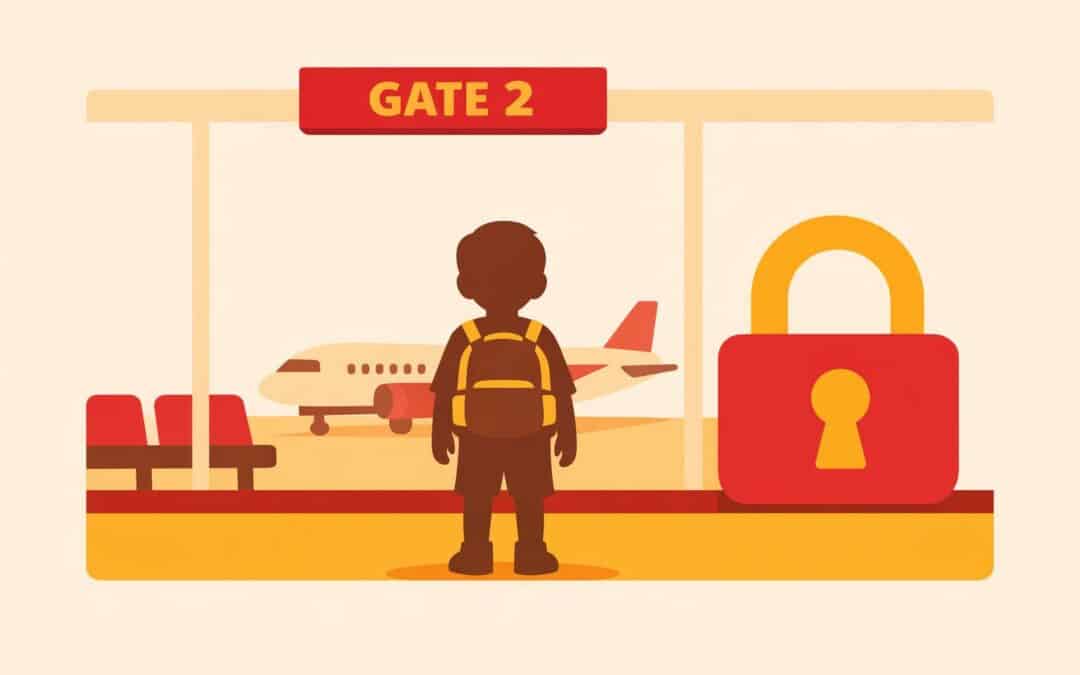
A ban on leaving the territory prevents one parent from taking the child out of France without the other’s agreement. You request it from the family affairs judge, urgently if needed. It is entered in the register of wanted persons.
You are worried that the other parent may take your child abroad without your consent? Perhaps they have mentioned a trip? Perhaps you have reasons to believe they would not come back? In that case, a concrete legal measure exists: the travel ban on children ordered by the French Family Court Judge (juge aux affaires familiales, or JAF).
This protective order prevents a child from leaving France without both parents’ agreement. Moreover, you can request it at any point — during divorce proceedings, a custody dispute, or as soon as a credible risk of parental abduction emerges.
Here is what you need to know in order to act effectively and at the right moment.
1. What Is a Travel Ban on a Child Ordered by the French Family Court?
A travel ban (interdiction de sortie du territoire, or IST) is a civil protective measure. The Family Court Judge pronounces it within the framework of parental authority proceedings. It prohibits the child from leaving France without the express agreement of both parents.
In practice, once the judge issues the order, the Public Prosecutor registers it in the National Wanted Persons Database (Fichier des personnes recherchées, FPR). Furthermore, the court may direct that it appears in the Schengen Information System (SIS), which gives the measure cross-border reach across Europe.
A « Relative » Ban — Not an Absolute One
The travel ban does not make all foreign travel impossible. It is described as « relative » because, if both parents agree to authorize a trip, departure remains possible.
However, that agreement must follow a strict procedure: both parents must formalize their consent before a judicial police officer (OPJ), at least five days before the planned departure date, except in duly justified exceptional circumstances.
The officer then sends the official record to the Public Prosecutor to update the database entry.
How Long Does the Measure Last?
Outside of a protection order, the travel ban carries no time limit.
It therefore remains in force until a new court decision lifts it, or until the child reaches the age of majority.
In contrast, when the judge pronounces the ban as part of a protection order — notably in domestic violence cases — it is generally limited to six months. Nevertheless, a court may extend it if divorce or custody proceedings begin before it expires.
2. What Circumstances Should You Request a Travel Ban for Your Child?
The Family Court does not grant a travel ban automatically. Instead, you must demonstrate a concrete and genuine risk of parental abduction or wrongful retention abroad.
The French Court of Cassation is clear on this point: judges must identify and articulate the risk precisely — general concern alone is not sufficient.
Situations That Justify a Travel Ban
In practice, several types of evidence can support a request for a travel ban:
-
-
- explicit threats to leave France with the child;
- signs of an imminent departure (purchased tickets, ongoing relocation, consular steps);
- a credible risk that the other parent will not return after a visit abroad;
- behavior suggesting the child would be in danger abroad;
- a history of non-compliance with court orders on the child’s residence.
-
What Does Not Justify a Travel Ban
In contrast, courts generally refuse the measure when the only argument is the child’s dual nationality or the other parent’s family ties abroad.
Taken alone, these factors do not establish a sufficient risk.
Consequently, you must support your request with concrete, documented evidence.
3. How to Obtain a Travel Ban Through the French Family Court
You bring the request before the Family Court Judge, who holds jurisdiction over all matters relating to parental authority.
You may include it within divorce proceedings, a residence order application, or file it as a standalone urgent request.
Build a Strong File
The judge applies rigorous scrutiny to the reasoning behind the decision. Therefore, your file must document the risk precisely: written messages, witness statements, emails, flight bookings, observed behavior — every element matters.
After the judge rules, the court clerk immediately notifies the Public Prosecutor, who registers the ban in the national database with the relevant identity information.
In an Emergency: The Public Prosecutor Can Act Immediately
If you cannot wait for a court hearing, another option is available. When a child is about to leave France in dangerous conditions and no parent protects them, the Public Prosecutor can urgently impose a travel ban for a maximum of two months. This emergency route allows action without waiting for a scheduled hearing.
Furthermore, if child protection proceedings are already open, the Children’s Court Judge (juge des enfants) may also order a travel ban, for a maximum of two years.
4. What Penalties Does a Parent Face for Breaching a Travel Ban?
A travel ban is a civil measure. However, breaching it can trigger serious criminal consequences. Indeed, taking a child abroad in violation of the court order may constitute:
-
-
- Failure to produce a child (Art. 227-5 French Criminal Code): up to 1 year’s imprisonment and a €15,000 fine;
- Abduction of a minor by an ascendant (Art. 227-7 French Criminal Code): up to 1 year’s imprisonment and a €15,000 fine.
-
In addition, when the travel ban forms part of a protection order, breaching any associated obligation constitutes a separate criminal offence. As a result, the civil protective measure carries significant criminal weight.
Moreover, these penalties complement the mechanisms of the 1980 Hague Convention on International Child Abduction, which allows you to secure your child’s return from a foreign signatory country.
5. Frequently Asked Questions About Travel Bans in France
Is a travel ban automatic during a high-conflict separation?
No. The judge assesses each situation individually and requires concrete evidence of a real risk. The existence of a parental conflict alone does not justify the measure.
Can we still travel abroad despite a travel ban?
Yes, provided both parents agree. However, they must formalise their consent before a judicial police officer at least five days before departure. Without that step, border services block the child’s exit.
Does the travel ban appear in official databases?
Yes. The court systematically registers it in the National Wanted Persons Database (FPR). Depending on the judge’s instructions, it may also appear in the Schengen Information System (SIS), giving it European reach.
How do you lift a travel ban once the risk has passed?
You must apply to the Family Court Judge for the order to be lifted. Without that application, the ban automatically ends when the child turns 18.
Act Before It Is Too Late
A travel ban is an effective protective tool — but only if you request it at the right time and with a solid file. Waiting until the risk materializes means risking that your child is already gone.
If you are worried the other parent may take your child abroad, schedule a consultation without delay for a personalized assessment and rapid legal action.
Texte : Article 373-2-6 Civil Code.
(C) Photo : AI
FAQ
How do you request a travel ban?
By a request to the family judge. In emergencies, a fast-track procedure allows the measure to be obtained quickly.
How does it differ from a temporary objection?
A temporary objection is a short administrative measure. The judge-ordered ban is lasting.
How long does the measure last?
Until the child reaches adulthood, unless the judge decides otherwise or both parents agree.
About me · Book a consultation