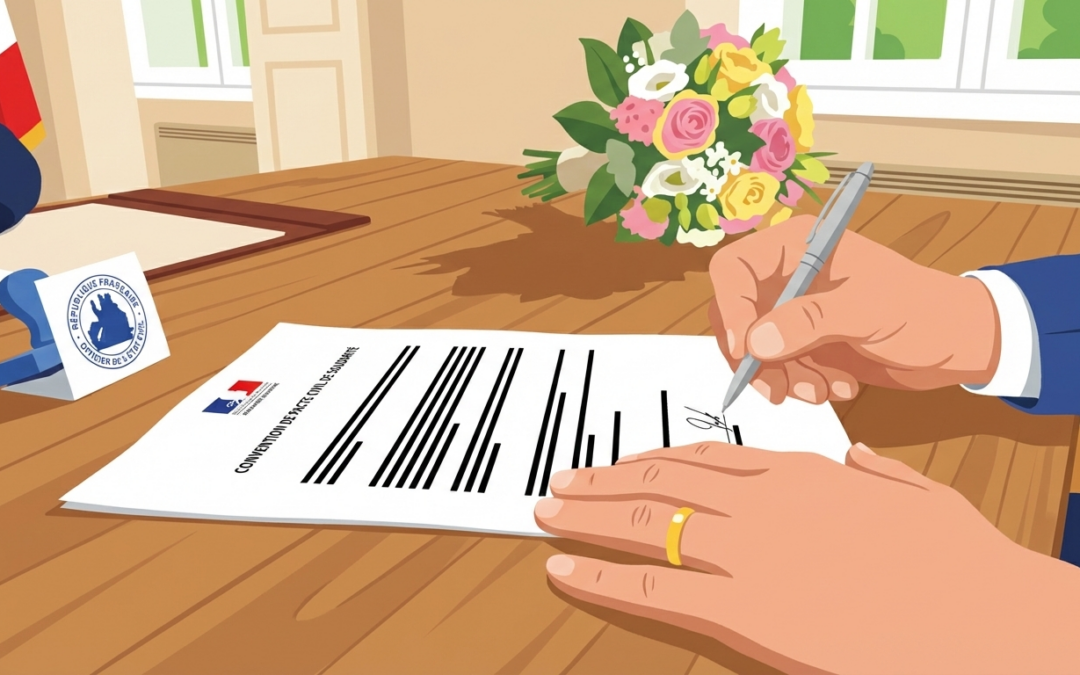
The Pacte Civil de Solidarité (PACS) is a civil union created by the French law of November 15, 1999.
Today, it stands as a major alternative to marriage and informal cohabitation.
This civil contract allows two adults—whether of the same sex or different sexes—to organize their shared life with a legally recognized partnership.
Below is a comprehensive guide to PACS requirements, registration, property rules, and the legal consequences of this civil union.
1. Who Can Enter Into a PACS Civil Union?
To enter into a PACS partnership, both partners must meet specific legal conditions:
-
-
- Be two adult persons.
- Not be married or already in a PACS.
- Have no close family relationship (up to the 3rd degree).
-
Your nationality does not matter: you may conclude a PACS as long as you reside in France.
2. How to Register a PACS? Essential Steps
The PACS process involves two key steps.
2.1. Drafting the PACS Agreement
The partners must draft a written agreement. There are two formats:
-
-
- Private agreement (acte sous seing privé) : A contract written and signed by the partners themselves.
- Authentic notarized agreement (acte authentique): A PACS drafted and executed before a notary, offering stronger legal security.
-
2.2. Official Registration
Since 2017, PACS registration may be completed:
-
-
- at the city hall of the couple’s joint residence, or
- with a notary.
-
This creates an official date and triggers the legal effects of the contract.
Important Note: To make the PACS enforceable against third parties, a notation is added to each partner’s French birth certificate.
3. Which Property Regime Applies to Your PACS?
Choosing a property regime is crucial for managing joint assets. Since 2007, two regimes are available:
3.1. Separate Property (Default Regime)
Each partner remains the exclusive owner of assets acquired individually.
This option ensures full financial independence.
3.2. Joint Ownership (Optional Indivision)
Assets acquired after the PACS registration belong to both partners 50/50, regardless of who actually financed the purchase.
Comparison Table
| Characteristic | Separate Property | Joint Ownership (Indivision) |
| Default? | Yes | No |
| Ownership | Individual | Shared 50/50 |
| Debts | Individual | Joint for daily expenses |
4. PACS vs Marriage: What Are the Differences?
Couples often hesitate between marriage and PACS. Key differences include:
-
-
- Duties: Marriage imposes duties of fidelity and support; PACS focuses on material assistance and joint life.
- Parenthood: PACS has no automatic effect on parental authority or adoption.
- Ending the union: Ending a PACS is much simpler and faster than divorce.
-
5. Tax Benefits and Financial Advantages of PACS
One of the major strengths of PACS is its favorable tax treatment.
Partners benefit from:
-
-
- Joint income taxation starting in the year the PACS is concluded,
- Full exemption from inheritance tax (similar to spouses),
- Significant allowances for gifts between partners.
-
These benefits are far more advantageous than simple cohabitation, which provides no tax rights.
6. How to Dissolve a PACS Civil Union
A PACS is known for its flexibility. It may be dissolved in three ways:
-
-
- Joint Agreement : A simple written joint declaration.
- Unilateral Decision : One partner may terminate the PACS by having a process server notify the other partner.
- Automatic Dissolution : Occurs in the event of marriage or death of one partner.
-
In case of disputes regarding property division or child custody, the Family Court Judge may intervene.
Conclusion: A Flexible and Protective Legal Framework
The PACS civil union offers an ideal balance between legal protection and administrative simplicity.
With its simplified management, favorable tax treatment, and flexible dissolution process, it provides a strong alternative for couples wishing to structure their relationship without the obligations of marriage.
Need assistance drafting your PACS agreement or choosing your property regime?
Do not hesitate to schedule an appointment. I can help you prepare your PACS, anticipate its consequences, and manage its dissolution if necessary.
© Photo : AI