Last updated on juillet 7, 2026
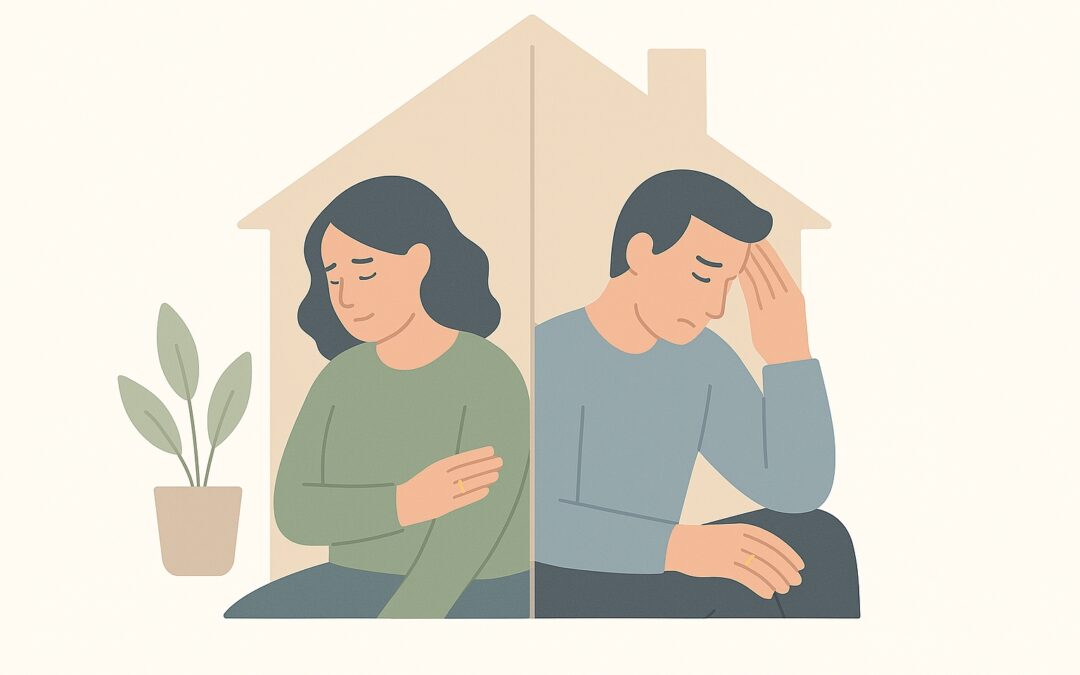
Legal separation ends the duty to live together without ending the marriage. The spouses stay married but live apart, with a division of assets. It can be converted into divorce after two years.
It is a lesser-known legal procedure than divorce, yet it can be a relevant and strategic alternative for certain married couples.
1. Legal basis and definition of legal separation
Legal separation allows spouses to remain legally married while putting an end to the obligation of cohabitation.
It does not dissolve the marriage but terminates the duty to live together and results in the separation of property between the spouses.
Legal separation is therefore an adjustment of the marital relationship rather than its dissolution, unlike divorce.
It is often chosen for religious, personal, or financial reasons, or where spouses do not wish to permanently sever the marital bond.
2. Legal separation procedure
2.1 Grounds and legal basis
Legal separation may be granted on the same grounds and under the same conditions as divorce under French law:
2.2 Mutual consent: with or without court involvement
Following recent reforms, legal separation by mutual consent may be carried out without court proceedings, except in specific situations, notably where:
-
-
- a minor child requests to be heard by the judge; or
- one spouse is subject to a protective legal measure.
-
In such cases, the separation agreement is drafted by the spouses’ attorneys and filed with a notary.
2.3 Judicial legal separation
In the absence of full agreement, or where legal exceptions apply, legal separation is ordered by the Family Court judge (Juge aux affaires familiales).
The judge rules on the consequences of the separation, including spousal support, housing arrangements, and the division of property.
2.4 Conversion into divorce
Legal separation may be converted into divorce at any time:
-
-
- by mutual agreement of the spouses; or
- at the request of one spouse after a two-year period.
-
3. Legal effects and differences compared with divorce
3.1 Continuation of the marital bond
Unlike divorce, legal separation does not dissolve the marriage.
The spouses remain legally married, which preserves certain rights attached to marital status, particularly regarding surname, inheritance rights, and survivor’s pension benefits.
3.2 Continuing duties and obligations
-
-
- Duty of fidelity: this obligation continues after legal separation.
- Duty of support: it remains in force and generally results in the payment of spousal maintenance to the spouse in need.
- Duty of cohabitation: this obligation ends.
-
3.3 Matrimonial property regime: automatic separation of property
Legal separation automatically results in a separation of property regime, even if the spouses were previously married under a community property regime.
3.4 Donations and matrimonial advantages
Matrimonial advantages and inter vivos gifts that take effect during the marriage are maintained.
However, benefits intended to take effect upon dissolution of the marriage or upon death are automatically revoked, unless the spouse who granted them expressly decides otherwise.
4. Advantages of legal separation
-
-
- Respect for religious or personal convictions: legal separation allows spouses to live apart without dissolving the marriage.
- Preservation of marital rights: certain inheritance rights and survivor benefits are maintained.
- Protection of a financially vulnerable spouse: the duty of support continues.
- Financial independence: automatic separation of property ensures individual management of assets.
-
5. Drawbacks and limitations
-
-
- Continuation of the marital bond: remarriage is not possible.
- Potential subsequent proceedings: legal separation may later lead to divorce, involving additional procedures and costs.
- Financial complexity: liquidation of assets may be complex, particularly in cases of jointly owned property.
- Ongoing obligations: duties of fidelity and support remain in force.
-
6. Summary table: legal separation vs divorce
| Aspect | Legal Separation | Divorce |
| Dissolution of marriage | No | Yes |
| Duty of cohabitation | No | No |
| Duty of fidelity | Yes | No |
| Duty of support | Yes (spousal maintenance possible) | No after divorce |
| Matrimonial regime | Automatic separation of property | As determined by law or court |
| Inheritance rights | Yes | No |
| Remarriage | No | Yes |
| Conversion possible | Yes (into divorce) | — |
7. Conclusion
Legal separation offers an intermediate solution between married life and divorce, allowing spouses to live apart while preserving certain marital ties and protections.
It may be particularly appropriate for couples wishing to maintain the marital bond or protect a vulnerable spouse.
However, it also entails ongoing obligations and potential financial complexity. Choosing legal separation therefore requires careful consideration and professional legal guidance.
For further information or legal assistance, you may schedule a consultation.
Source : Art. 296 – 304 Civil Code.
© Photo: AI
FAQ
How does legal separation differ from divorce?
Legal separation does not end the marriage: you stay married without living together. Divorce dissolves the marriage.
Can you remarry after a legal separation?
No. While the marriage subsists, remarriage is impossible. You must first convert the separation into divorce.
How is separation converted into divorce?
After two years of legal separation, either spouse can request conversion into divorce, granted by the judge.
About me · Book a consultation