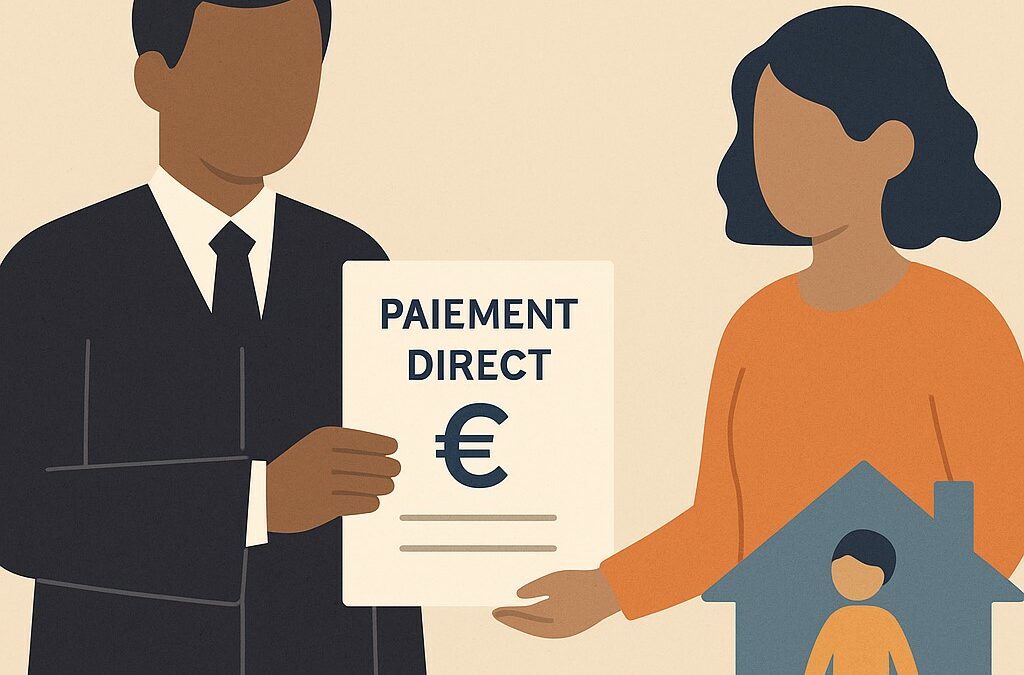
Direct payment is a legal mechanism that remains relatively unknown to the general public but is particularly useful for guaranteeing the payment of support obligations by a debtor.
It can be used to recover child support owed either under the spousal duty of support or under the obligation to contribute to the maintenance and upbringing of children.
This procedure, designed to protect support creditors, helps avoid recurring non-payment issues.
This article explains the scope of this procedure, the conditions for its use, its advantages, and its limitations.
1. What Is Direct Payment?
Direct payment is a simplified legal procedure that allows the creditor of a support obligation to collect the amounts owed directly from a third-party debtor (such as an employer, a bank, or a pension fund) that holds funds payable to the support debtor.
This mechanism, established by Law No. 73-5 of January 2, 1973, and codified in the French Code of Civil Enforcement Procedures, was designed to make child support recovery faster and to avoid lengthy court actions for the creditor.
2. Conditions for Using Direct Payment
Direct payment may be used under specific legal conditions:
-
-
-
-
- A valid, liquid, and due claim: The support obligation must be established by an enforceable court decision or an instrument with binding effect, such as a notarized deed or a court-approved agreement.
- Non-payment: Direct payment is triggered when a support payment has not been made—whether partially, entirely, or late.
- A request through a bailiff (huissier de justice): The creditor must contact a bailiff, who verifies that the legal conditions are met before notifying the third-party debtor.
-
-
-
3. Advantages of Direct Payment
Direct payment provides several key benefits for support creditors:
-
-
- Speed: Once the conditions are met, direct payment can be implemented within days.
- Efficiency: The creditor does not need to prove bad faith or fault on the debtor’s part; the procedure is based solely on non-payment.
- Security: The sums are collected directly from the third-party debtor, reducing the risk of insolvency.
-
4. Limitations and Exceptions to Direct Payment
Despite its effectiveness, direct payment has some limitations:
-
-
- Restricted to the last six months of arrears: As a rule, only the unpaid installments from the six months prior to notification can be recovered through this procedure.
- Ineffectiveness in case of insolvency: If the debtor has no attachable income (e.g., unemployment or personal bankruptcy), the procedure is ineffective.
- Force majeure exceptions: The debtor may contest direct payment by invoking circumstances beyond their control, such as a banking error.
-
5. Difference Between Direct Payment and Financial Mediation
Direct payment allows the support creditor to obtain payments directly from a third party holding funds for the debtor (such as an employer or bank).
Financial intermediation, on the other hand, involves a public family benefits agency (such as CAF or MSA in France) collecting child support payments from the debtor and transferring them to the creditor, thereby simplifying the process and reducing direct contact between parents.
Conclusion
Direct payment is a powerful and effective tool to secure the recovery of child support, particularly in cases of repeated non-payment.
However, it is essential to meet all the legal requirements and confirm the validity of the claim.
If you are facing difficulties in collecting child support, you should consult a family law attorney.
They can guide you through this procedure and defend your rights.
For more information or personalized advice, do not hesitate to schedule an appointment.
© Photo : IA